Nurseinfo.in provides free Nursing Notes, Nursing Procedures, Medical MCQs, Nursing Calculators, Care Plans and exam preparation resources for BSc Nursing, GNM, P.B. BSc and MSc Nursing students. Browse subject-wise notes, previous year questions and study materials based on the latest nursing syllabus.
Nurseinfo.in provides free Nursing Notes, Nursing Procedures, Medical MCQs, Nursing Calculators, Care Plans and exam preparation resources for BSc Nursing, GNM, P.B. BSc and MSc Nursing students. Browse subject-wise notes, previous year questions and study materials based on the latest nursing syllabus.
In Kuwait, the staff nurse earn about 1,040 KWD per month
(average), lowest salary for nurses is 500 KWD per month and highest salary is
about 1,630 KWD per month.
Nurse with
less than 2 years experience earns 580 KWD per month and nurse with good
experience about 20 + years experience will get 1,560 KWD per month.
Less than 2
years – 580 KWD per Month
2 to 5 years
– 830 KWD per Month
5 to 10
years – 1,090 KWD per Month
10 to 15
years – 1,340 KWD per Month
15 to 20
years – 1,420 KWD per Month
20 + years –
1,560 KWD per Month
Nurse Salary by Education
Nurse with
bachelor degree will get 920 KWD per month and nurse with master degree earn
1,310 KWD per month.
Nurse Salary
with Bachelor’s Degree – 920 KWD per Month
Nurse Salary
with Master’s Degree – 1,310 KWD per Month
Nurse Salary by Job Title
Nurse with
job title “staff nurse” earn 970 KWD per month, “nursing director” with
experience will get 2440 KWD per month.
The factors
that define the nurse salary are location, experience and education. Job title also
plays a vital role in determining the nurse salary.
BAHRAIN
Bahrain offers good nursing salary about 14,300 BHD per
annum. Average salary of nurses is 1,190 BHD per month, the lowest salary is
560 BHD per month and highest salary for nurses is 1,880 per month
Staff nurse
salary 14300 BHD per Annum.
Average
salary – 1,190 BHD per month, lowest salary – 560 BHD per month and highest
salary – 1,880 per month (for more salary details scroll down)
Staff Nurse Salary by Experience
Staff nurse earn
good if they have good experience, for instance, the nurse with 20 + year
experience earns 1,780 per month. Nurses with less than 2 years of experience
or fresher earn 650 BHD per month. Depending on experience, the nurse’s salary will
be increased each year.
Less than 2
years – 650 BHD per month
2 to 5 years
– 890 BHD per month
5 to 10
years – 1,270 BHD per month
10 to 15
years – 1,550 BHD per month
15 to 20
years – 1,630 BHD per month
20 + years –
1,780 BHD per month
Salary Based on Education
Degree plays
a vital role in determining the salary for nurses. For example, nurse with
bachelor degree get 890 BHD per month and nurse with master degree, will get
1,630 BHD per month
Nurse with
Bachelor Degree – 890 BHD per month
Nurse with
Master Degree – 1,630 BHD per month
Nurse Salary with Different Job Title
Based on job
title the nurse’s salary will be greatly varied. With experience and job title,
the nurse’s salary will be good, for example, nursing director earn about 2960
BHD per month, “Nurse” title earn 1380 BHD per month.
JOB
TITLE
SALARY
(BHD per month)
Acute
Care Nurse
1340
Assistant
Director of Nursing
2130
Case
Manager
1780
Company
Nurse
1020
Critical
Care Nurse
1370
District
Nurse
1180
Head
Nurse
1420
Home
Nurse
1160
ICU
Registered Nurse
1320
Informatics
Nurse Specialist
1370
Licensed
Practical Nurse (LPN)
1230
MDS
Coordinator
1280
Mental
Health Nurse
1310
Neonatal
Nurse Practitioner
1660
Nurse
1380
Nurse
Midwife
1380
Nurse
Practitioner
1460
Nursing
Assistant
1090
Nursing
Coordinator
1440
Nursing
Director
2960
Nursing
Services Instructor
1310
Nursing
Supervisor
1770
Occupational
Health Advisor
2230
Occupational
Therapist
1870
Personal
Support Worker
970
Psychiatric
Nurse
1190
Registered
Nurse
1250
Respiratory
Manager
2370
School
Nurse
1080
Staff
Nurse
1190
Theatre
Manager
2040
Utilization
Review Nurse
1240
IRAQ
In Iraq, the
average staff nurse earns 1,980,000 IQD per month; lowest salary per month is
1,270,000 IQD per month highest salary for nurses is 3,810,000 IQD per month.
Average
staff nurse salary – 1,980,000 IQD per month
Salary –
1,270,000 IQD (lowest) per Month and 3,810,000 IQD (highest) per Month
Nurse Salary with Job Title
Like other
countries, Iraq provides good salary for nurses based on their job title and
education. For example, respiratory manager earns good salary of about
3,400,000 IQD per month and head nurse earns 2060000 IQD per month
JOB
TITLE
SALARY
(IQD per month)
Acute
Care Nurse
2010000
Assistant
Director of Nursing
3140000
Case
Manager
2290000
Company
Nurse
1340000
Critical
Care Nurse
1930000
District
Nurse
1770000
Head
Nurse
2060000
Home
Nurse
1660000
ICU
Registered Nurse
1750000
Informatics
Nurse Specialist
1790000
Licensed
Practical Nurse (LPN)
1670000
MDS
Coordinator
1900000
Mental
Health Nurse
1850000
Neonatal
Nurse Practitioner
2330000
Nurse
1740000
Nurse
Midwife
2100000
Nurse
Practitioner
1980000
Nursing
Assistant
1450000
Nursing
Coordinator
1900000
Nursing
Director
3840000
Nursing
Services Instructor
1850000
Nursing
Supervisor
2470000
Occupational
Health Advisor
3130000
Occupational
Therapist
2800000
Personal
Support Worker
1310000
Psychiatric
Nurse
1660000
Registered
Nurse
1680000
Respiratory
Manager
3460000
School
Nurse
1490000
Staff
Nurse
1620000
OMAN
In Oman, the
nurse average salary is about 1,710 OMR per month; lowest is 1,100 OMR per
month and highest salary for nurses is 3,290 OMR per month.
Nurse salary
average – 1,710 OMR per month, lowest salary – 1,100 OMR per month and highest
salary – 3,290 OMR
Nurse Salary by Job Title
In Oman,
acute care nurse earn 1510 OMR per month, head nurse earn 1540 OMR per month
and nursing director with good experience will get 3120 OMR per month.
Ireland has
many designations for nurse right from student nurse to group director of
nurses. Nurses have great opportunity to grow and enhance themselves in their
career in Ireland. Following their career their pay scale also increases
according to their experience and roles. Ireland has good LSI (Long Time
Service Increment) for nurses. LSI applies to all of the nurses with aggregate
recognised service will be reckonable for the purposes of entitlement to LSI
i.e. he/she will acquire an entitlement to an LSI after the same number of
years service as his/her equivalent in the Irish public health service e.g. a
newly appointed non-national staff nurse who has 12 or more years’ recognised
nursing service will be entitled to be placed on the LSI. The requirement that
the employee was in receipt of the maximum point of the salary scale for three
years no longer applies.
Nursing Designation Hierarchy (Top to
Low Position)
Hospital Group Director of Nursing and Midwifery
Director Centre of
Nurse Education
Director – Nursing &
Midwifery Planning Dev Unit
Area Director –
Nursing & Midwifery Planning Dev Unit
Director of Nursing
Band 5
Director of Nursing
Band 4
Director of Nursing
Band 3
Director of Nursing
Band 2a
Director of Nursing
Band 2
Director of Nursing
Band 1
Assistant Director of
Nursing Non Band 1 Hospitals
Ireland Nurse’s Salary Based on Grade
and Experience
Hospital Group Director of Nursing
and Midwifery
The highest rank or position one can hold in Ireland as a registered nurse is Hospital Group Director of Nursing and Midwifery. With handful of nursing experience and team handling skills a nurse will be appointed as Hospital Group Director. Their hike or salary increment will be done each year as per salary guide. Below is the salary guidance for hospital group director position (€ per annum)
Director Center of Nurse Education
This position is the second highest position for nurses in Ireland. They will work closely with the Hospital Group Director of Nursing and Midwifery and Directors of Planning and development. Their main agenda is to lead the educational, training and development strategy and operational plan for Nursing Education. Their other roles and responsibilities will be defined by the Hospital Group Director of Nursing and the board of Directors. Below is the salary guidance for Director Center of Nurse Education position (€ per annum)
Director – Nursing & Midwifery
Planning Development Unit && Area Director – Nursing & Midwifery
Planning Development Unit
Director will focus mainly on planning and development activities of nursing and midwifery. They will be handling Area Director and team of planning and development. Below is the salary guidance for both Director and Area director of Planning and Development positions (€ per annum)
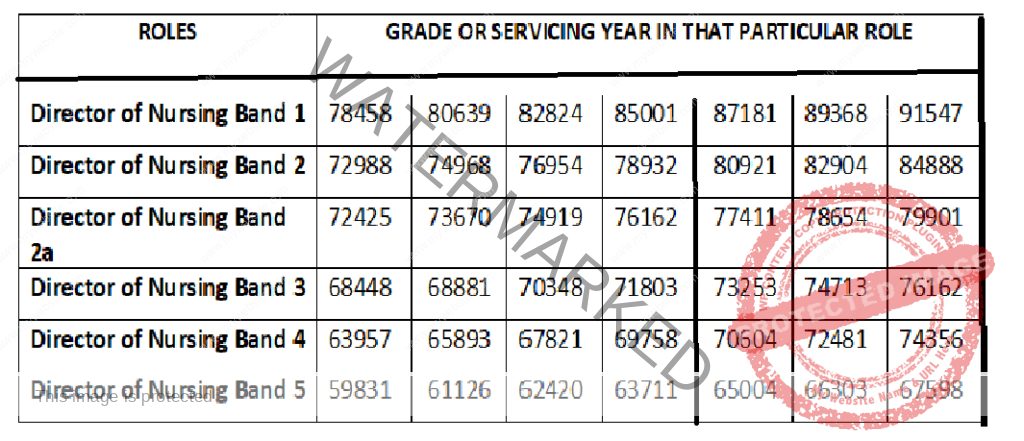
Director of Nursing
The Director of Nursing has 6 bands and below is the salary guide (€ per annum)
Assistant Director of Nursing Band 1
& Non Band 1
This position is classified into two parts according to the band 1 and non band 1 hospitals in Ireland. Below is the salary guide for this position (€ per annum)
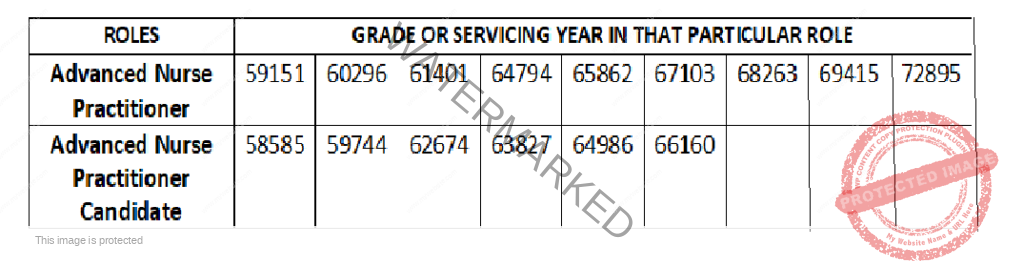
Advance Nurse Practitioner
The salary guide for Advance Nurse Practitioner and Advance Nurse Practitioner Candidate (€ per annum)
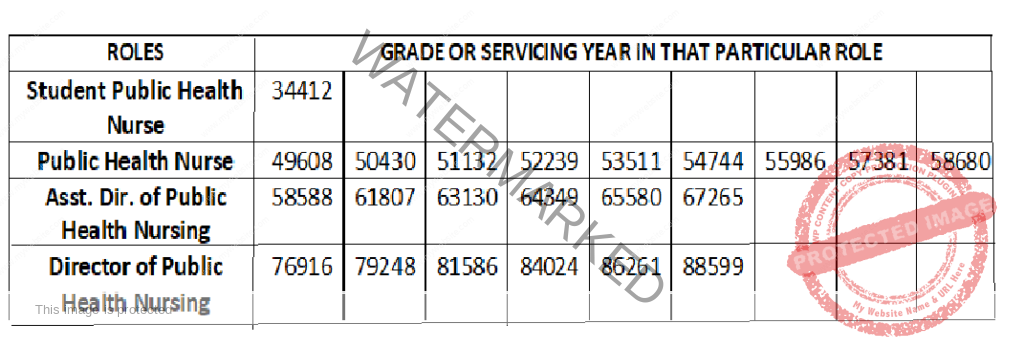
Public Health Nursing Department
Public Health nursing department has four different roles namely, Student Public Health Nurse Public Health Nurse and Director and Assistant Director of Public Health Nursing. The salary for these positions are illustrated below (€ per annum)
On red
circle basis allowance (€1686 per annum) will be provided for the above
mentioned positions who were in posts on 5/11/’99.
For
theatre/Night nurses who were in posts on 5/11/’99 will be taken on red circle
basis and the allowance range will be €843 per annum.
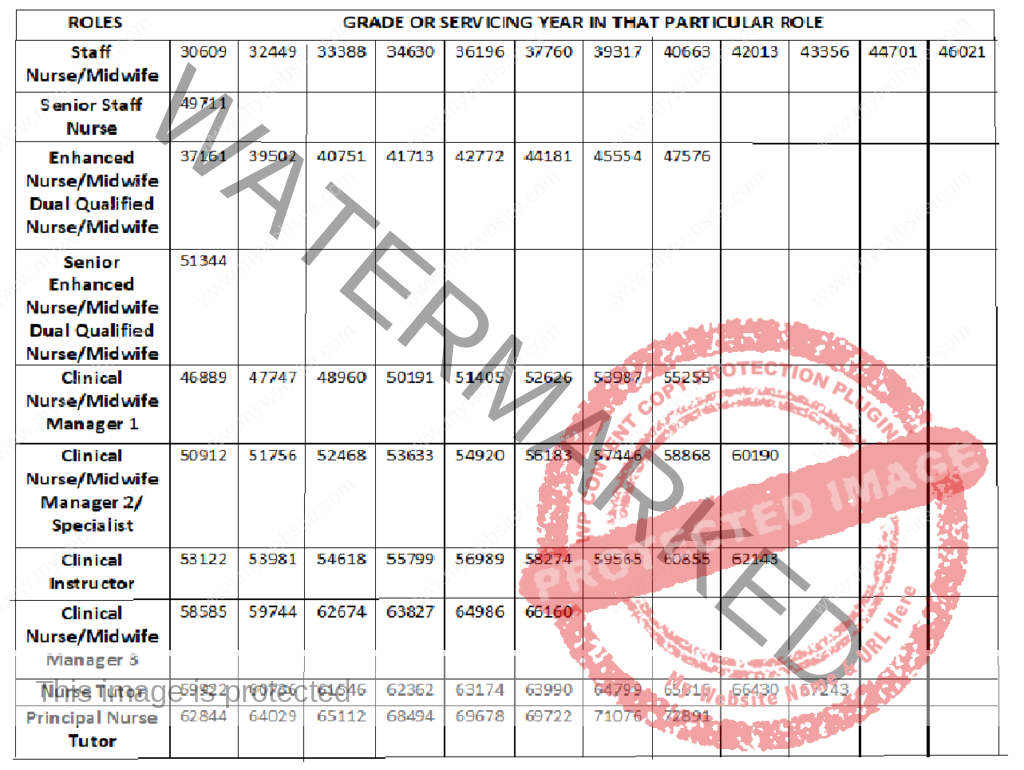
Other Roles and Salary Structure
Below are the other roles of nurses and their salary structures (€ per annum)
Staff nurse
and Midwife post qualification nurses who are in pre-registration segment will
be offered 26179 € per annum. They
will be promoted to next level after registration.
Student Nurse/Midwife/Intellectual
Disability
In Ireland, nurse begins as “Student Nurse/Midwife/Intellectual Disability” from here they move up the ladder to top most position “Director of Nursing” grade. The average salary for Student Nurse is 15056 € Per Annum. Salary will be based on 36 weeks rostered placement for degree students.
LSI (Long
time Service Increment) for staff nurse / midwifery after 3 years maximum will be €47431 per annum and for Senior staff nurse
and Enhanced Nurse/Midwife Dual Qualified Nurse/Midwife after 3 years maximum will be €48987 per annum
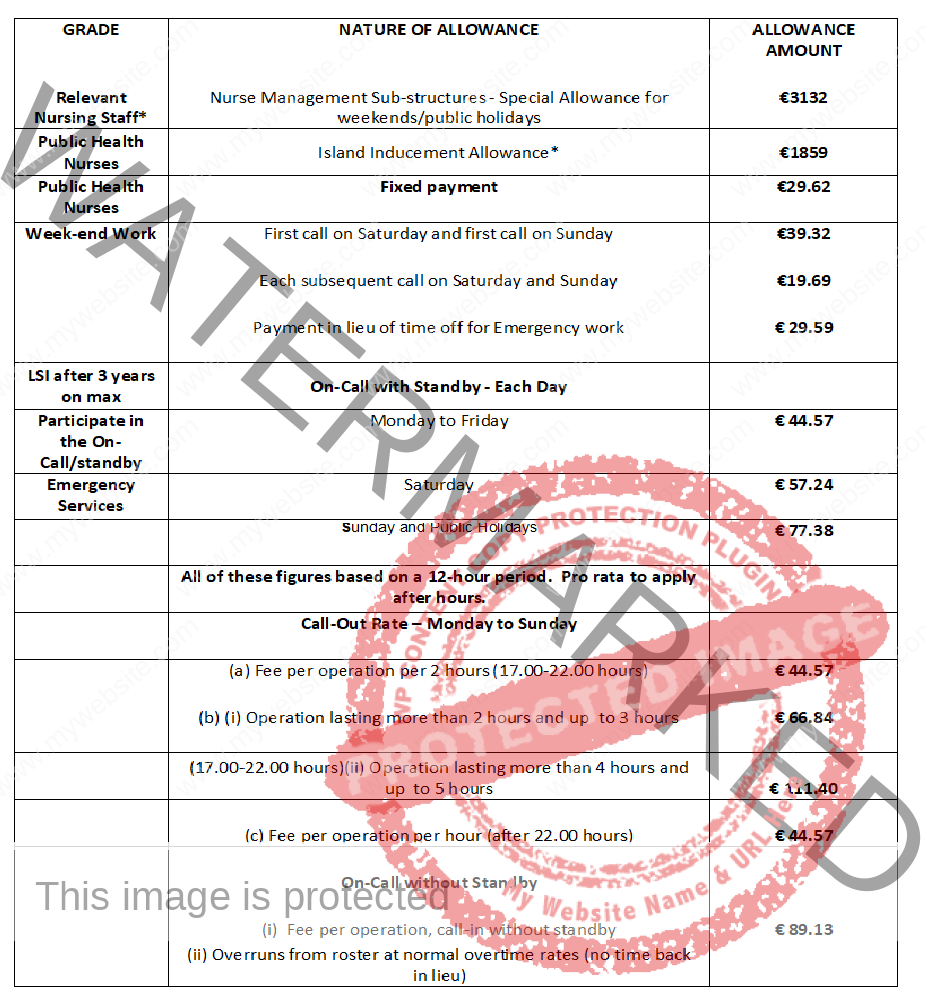
ALLOWANCES FOR NURSES
Registered Nurses Employed on duties
in the following departments receive €2347 as allowance
Accident & Emergency Department
Theatre/O.R.,
Renal Units,
Intensive/Coronary Care Units,
Cancer/Oncology Units,
Geriatric Units/Long-Stay Hospital or
Units in County Homes. High Dependency Units,
Neo Natal Units (ICU),
Endoscopy Units,
Specialist Ambulatory
Dialysis Units.
Units for Severe and Profoundly
Handicapped in Mental Handicap Services, Acute Admission Units in Mental Health
Services, Secure Units in Mental Health Services, dedicated Care of the elderly
(excluding Day Care Centres) and Alzheimers Units in Mental Health Services and
the
Intellectual Disability Sector
(including Psycho-geriatric Wards, Elderly Mentally Infirm Units, Psychiatry of
Later Life Services).
Medical/Surgical Wards, Maternity
Departments
Registered Nurses Employed on duties
in specialist areas appropriate to the following qualifications where they hold
the relevant qualification will receive € 3525 as allowance
Accident & Emergency Nursing
Course
Anaesthetic Nursing Course
Behaviour Modification Course
Behavioural Therapy Course
Burns Nursing Course
Child & Adolescent Psychiatric
Nursing Course
Coronary Care Course
Diabetic Nursing Course
Ear Nose & Throat Nursing Course
Forensic Psychiatric Nursing Course
Gerentological Nursing Course
Higher Diploma in Midwifery
Higher Diploma in Pediatrics
Infection Control Nursing Course
Intensive Care Nursing Course
Pediatrics Intensive Care
Special and Intensive Care of New
Born
Neurological/Neurosurgical Nursing
Course
Operating Theatre Nursing Course
Pediatric Operation Theatre
Opthalmic Nursing Course
Orthopaedic Nursing Course
Higher Diploma in Cardiovascular
Nursing/Diabetes Nursing/Oncological Nursing/Palliative Care Nursing/Accident
and Emergency Nursing Rehabilitation Nursing Course
Renal Nursing Course
Stoma Care Nursing Course
Registered General Nurses holding recognized postregistration qualifications in midwifery or sick children’s nursing and employed on duties appropriate to their qualification will receive €3525 as allowance.
On-Call over Weekend
In
situations where no roster duty is available over the weekend, the following
will apply on a pro-rata basis (i.e. appropriate rate divided by 12, then
multiplied by number of hours available).
No time back in lieu will apply.
Nurse Coordinator Allowance
A shift allowance of €19.04 will be paid to a staff nurse who undertakes the role of formalizing the reporting and accountability relationship with the Theatre Superintendent. The allowance only applies to a nurse who fulfils specified duties when called in. For Specialist Coordinator Allowance is €4,546.
Nurses Salary in United Kingdom – based
on Grade and Experience
The nurse’s
salary depends on various factors such as education, experience and in which designation
(band) nurses works. The average salary for Registered Nurses in United Kingdom
is 25,460 GBP per annum.
Nurse Designation
In United
Kingdom, Nurse Designation is divided into two types, Registered and Staff
Nurse. Below is the detailed hierarchy of nurse designation in UK
Registered Nurse (RN)
Staff Nurse
Nurse Practitioner (NP)
Charge Nurse (RN)
Staff Nurse
Registered Nurse (RN)
Charge Nurse (CN)
Registered Nurse (RN), Operating Room
Salary for Experienced Nurses
The Nursing
and Midwifery Council (NMC) is the regulator for nursing and midwifery
profession in United Kingdom. This governing body control and regulates nursing
profession in England, Wales, Scotland and Northern Ireland. Salary between
public sector particularly NHS staff and private sector is greatly varied.
Newly
Graduated Nurse will come under Band 5 and will earn 24, 920 GBP per annum. All
newly-qualified nurses come under band five. Band six is usually called Nurse
Specialist or Senior Nurse who earn between 31,430 to 37,960 GBP. Band 7 is
called Advanced Nurse/Nurse Practitioner who earns 38,980 to 44,650 GBP and
Band 8 is called Modern Matron or Chief Nurse who get 45,845 to 87,834 GBP. The
final band of grade 9 is called as Consultant who earns 91,130 to 104,970 GBP
Band 5 –
Newly Qualified Nurse
Band 6 –
Nurse Specialist or Senior Nurse
Band 7 –
Advanced Nurse/Nurse Practitioner
Band 8 –
Modern Matron or Chief Nurse
Band 9 –
Consultant
SALARY
Band 5 NHS
Nurse – 24,920 GBP
Band 6 NHS
Nurse – 31,430 to 37,960 GBP
Band 7 NHS
Nurse – 38,980 to 44,650 GBP
Band 8 NHS
Nurse – 45,845 to 87,834 GBP
Band 9 NHS
Nurse – 91,130 to 104,970 GBP
Registered
Nurse (RN) will earn good salary when their experience and band increases.
Band
Minimum
years of experience
Pay
1
0-1
£18,005
0-1+
£18,005
2
0-1
£18,005
2-Jan
£18,005
3-Feb
£19,337
4-Mar
£19,337
5-Apr
£19,337
6-May
£19,337
6+
£19,337
3
0-1
£19,737
2-Jan
£19,737
3-Feb
£21,142
4-Mar
£21,142
5-Apr
£21,142
6-May
£21,142
6+
£21,142
4
0-1
£21,892
2-Jan
£21,892
3-Feb
£21,892
4-Mar
£24,157
5-Apr
£24,157
6-May
£24,157
6+
£24,157
5
0-1
£24,907
2-Jan
£24,907
3-Feb
£26,970
4-Mar
£26,970
5-Apr
£27,416
6-May
£27,416
7-Jun
£30,615
7+
£30,615
6
0-1
£31,365
2-Jan
£31,365
3-Feb
£33,176
4-Mar
£33,176
5-Apr
£33,176
6-May
£33,779
7-Jun
£33,779
8-Jul
£37,890
8+
£37,890
7
0-1
£38,890
2-Jan
£38,890
3-Feb
£40,894
4-Mar
£40,894
5-Apr
£40,894
6-May
£41,723
7-Jun
£41,723
8-Jul
£44,503
8+
£44,503
8a
0-1
£45,753
2-Jan
£45,753
3-Feb
£45,753
4-Mar
£45,753
5-Apr
£45,753
5+
£51,668
8b
0-1
£53,168
2-Jan
£53,168
3-Feb
£53,168
4-Mar
£53,168
5-Apr
£53,168
5+
£62,001
8c
0-1
£63,751
2-Jan
£63,751
3-Feb
£63,751
4-Mar
£63,751
5-Apr
£63,751
5+
£73,664
8d
0-1
£75,914
2-Jan
£75,914
3-Feb
£75,914
4-Mar
£75,914
5-Apr
£75,914
5+
£87,754
9
0-1
£91,004
2-Jan
£91,004
3-Feb
£91,004
4-Mar
£91,004
5-Apr
£91,004
5+
£104,927
Nurses Salary in Private Hospital
Registered
Nurses (RN) who work in private sector or hospital earns more than public
sector (NHS) staff. Depend on location; the registered nurse salary will be
different.
NURSES SALARY IN CANADA – Based on
Grade and Experience
Canada
comparatively offers good salary for nurses than most of the countries in the
world. In Canada, nurses get approximately ~ $79,050 (CAD) per year or ~ $41.50
(CAD) per hour. Nurse’s salary in Canada depends on the location
(Province/Territory) they work in Canada, the experience they possess and the grade
they hold in their respective roles.
Nursing Designation in Canada
In Canada,
nursing designation is categorized by Licensed Practical Nurses (LPN),
Registered Psychiatric Nurses, Registered Nurses (RN) and Nurse Practitioners
(NP). These nursing personnel work in hospital, Community Health, Long-term
care and other. Apart from Registered Psychiatric Nurses all other nurses can
do registration in all 13 provinces and territories. Registered Psychiatric
Nurses registration can be done only in Manitoba, Saskatchewan, Alberta,
British Columbia and Yukon. Entry level education will differ for each
designation, for example, Licensed Practical Nurses need Diploma, and
Registered Psychiatric Nurses require Baccalaureate or diploma, Registered
Nurses (Baccalaureate) and Nurse’s Practitioners (Master Degree).
Registration Examination for
Different Designations
Licensed
Practical Nurses – Canadian Practical Nurse Registration Examination (CPNRE)
Registered
Psychiatric Nurses – Registered Psychiatric Nurses of Canada Examination
(Manitoba, Saskatchewan, Alberta and British Columbia)
Registered
Nurses – National Council Licensure Examination for RNs (NCLEX-RN)
Nurse
Practitioners – Different exams is conducted in healthcare settings (Primary
Health Care/Family, Pediatrics, Adult). For example, primary health care –
Canadian Nurse Practitioner Exam, pediatrics – Pediatrics Nursing Certification
board nurse practitioner exam, adult – various exams conducted in adult care.
Province/Territory in Canada (Highest
to Lowest Paid Wages) Approximately
Alberta
Northwest
Territories
British
Columbia
Saskatchewan
Ontario
Nova Scotia
Quebec
New
Brunswick
Newfoundland
and Labrador
Yukon
Manitoba
Prince
Edward Island
Alberta and
Northwest Territories offers good salary (highest) than the other province,
Manitoba, Prince Edward Island has lowest-paid wages.
Nurses Salary Based on
Grade/Experience (CAD)
Nurse’s
salary depends on their grade, experience and specialty. Fresher or entry level
nurses earn ~$42,840 CAD per annum; with good experience a nurse can get
~$96,434 per annum; Licensed Practical Nurse get ~$55,620 and Specialty nurse
with good experience earn more than $1,00,000 CAD per annum.
Fresher
(Entry Level) = ~ $42,840 per annum
Registered
Nurse (RN) = ~$82,730 per annum
Experienced
= ~$96,434 per annum
Most
Qualified and Experienced = more than $1, 00,000 per annum
Canadian
Licensed Practical Nurses (LPN) = ~$55,620
Personal
Support Workers = ~$38,030
Students =
20 $ to 30 $ per hour
Salary Based on Province, Grade and
Experience in Canada (CAD)
Province
Highest hourly wage
Lowest hourly wage
Average nursing salary
Alberta
$55.93
(Clinical Nurse Specialist with 9 years’ experience)
$27.68
(undergraduate nurse)
$94,422
British
Columbia
$53.14
(Level 6, or an RN or RPN working for over 9 years)
$27.20
(Level 1, or an LPN working for 1 year or less)
$78,456
Manitoba
$67.13
(weekend worker, Class 5 with over 20 years’ experience)
$30.58
(LPN in early career)
$41,396
New
Brunswick
$52.21
(Class D Registered Nurse with experience level F)
$31.32
(Class A RN starting out or a graduate nurse)
$69,030
Newfoundland
and Labrador
$56.50
(class 37 Nurse Specialist with Level 6 experience)
$31.82
(unregistered or student nurse)
$78,045
Nova
Scotia
$55.47
(specialty or primary health NPs with over 25 years’ experience)
$20.15
(LPN or Graduate Practical Nurse starting out)
$81,560
Ontario
$46.11
(nurses working for over 25 years)
$32.21
(RNs just starting out; excluding overtime/weekend/ holiday premiums)
$76,450
Prince
Edward Island
$56.38
(NP with over 25 years’ experience)
$32.48
(Level 1 RN in early career)
$65,345
Quebec
$53.49
(specialty NP with at least 18 years’ experience)
$20.73
(child or baby nurses just starting out)
$67,795
Saskatchewan
$58.69
(Step 5 Nurse Practitioner)
$31.07
(unlicensed grads)
$78,420
Northwest
Territories
Nurse
Practitioner
–
$103,590
Nunavut
Nurse Practitioner
–
$24,890
Yukon
Nurse
Practitioner
–
$88,910
Registered Nurses Salary in Different
Province in Canada (CAD)
Registered
Nurses are entitled to work in all 13 province and territories, depending on
their location of province, the salary differs. For example, urban location
gets more wages than rural places.
(AB) Alberta
$94,322
(BC) British Columbia
$78,546
(ON) Ontario
$76,362
(MB) Manitoba
$41,396
(NB) New Brunswick
$72,053
(NL) Newfoundland and Labrador
$78,059
(NS) Nova Scotia
$81,896
(PEI) Prince Edward Island
$69,713
(SK) Saskatchewan
$91,640
(NT) Northwest Territories
$94,107
(NU) Nunavut
$94,322
(YT) Yukon
$88,869
Most
Qualified and Experienced Nurses Salary in Canada (CAD)
This designation is given to the nurses who has
specialized qualification with education, experience and examination. Depend on
their designation, the salary will be varied.
Nursing Manager –
$86k per year
Certified Nurse
Midwife – $117k per year
Nurse Practitioner
(NP) – $95k per year
Forensic Nurse –
$82k per year
Clinical
Informatics Specialist –$77k per year
Clinical Research
Manager –$91k per year
Nurse Educator –
$93k per year
Clinical Nurse –
$89,690 per year
Registered Health
Nurse – $81,362
Operating Room
Nurse – $80,590
Community Health
Nurse – $80,420
Psychiatric
Registered Nurse – $80,650
Psychiatric Nurse
– $80,200
Case Manager –
$72,250
DON – $35,400
NURSES SALARY IN CANADA – Based on Grade and Experience
Singapore
nurses earn good wages as compared to other Asian Countries. Average staff
nurse get S$5950 SGD per Month (S$71, 550 per Annum). Salary for nurse in
Singapore depends on many factors, such as experience, education and grades. The
field and the position in which the nurse works will determine his/her salary
in Singapore. There are three different fields in Singapore namely, Clinical
Field, Management Field and Education Field. Top most position for nurses in these
fields is Director of Nursing (high ranked position for nurses in Singapore)
Staff nurse
with less than 2 year experience get S$3350 SGD, nurse with 2 to 5 years earns S$4750
SGD, 5 to 10 experience get S$6240 SGD, 10 to 15 years get S$7670 SGD, 15-20
Years get S$8160 SGD and nurse with 20 + experience get S$8940 SGD.
FIELD AND POSITION OF NURSES IN
SINGAPORE
Clinical Field
Management Field
Education Field
Role/Position Growth hierarchy for
each field is illustrated below: (each field’s hierarchy starts from lowest to
highest position)
The enrolled
nurse is authorized to carry out nursing assignments under delegation,
supervision or direction of a Registered Nurse, Advanced Practice Nurse and/or
Medical doctor. Enrolled nurse earns S$1800 SGD per month.
REGISTERED NURSE
The scope of
practice of a Registered Nurse (RN) is the range of functions,
responsibilities, activities and decision-making that the Registered Nurse (RN)
is authorized to perform. Registered Nurse role includes supervision of and
delegation to Enrolled Nurses and other Support Staff.
Registered
Nurses with Diploma in Nursing/Health Science earns S$2,500 SGD per Month and
registered nurses with Degree in Nursing will get S$3,500 SGD per Month.
STAFF NURSE
Staff nurse
play important role in Healthcare sector, their salary depends on the Private
and Public sector. In most cases, staff nurse earns more salary in private than
public sector. Staff nurse works in private hospital get S$2600 to S$4500 SGD
per month and in public (government) hospital get S$2200 to S$4540 SGD per
month.
Senior staff
nurse in private earns S$3350 to S$6000 SGD and in government (Public) get S$3100
to S$6300 SGD per month.
NURSE MANAGER
Nurse
Manager main role is to manage a ward or department in a healthcare
institution. Role and responsibilities of manager is to manpower resourcing,
planning and retention of manpower, job evaluation and re-design and policy
review and modification of policies if requires, mostly policies will be
determined and modified by the healthcare management and the Director of
Nursing. Nurse Manager in Public sector earns S$4,900 to S$8000 SGD per month
and in Private sector get S$4560 to S$9230 SGD per month.
Enrolled
Nurse – S$1,800 SGD (Monthly)
Registered
Nurse (Diploma in Nursing/Health Science) – S$2,500 SGD
Registered
Nurse (Degree in Nursing) – S$3,5s00 SGD
Staff Nurse
(Private) – S$2,600 SGD to S$4,500 SGD
Staff Nurse
(Public) – S$2,200 SGD to S$4,540 SGD
Senior Staff
Nurse (Private) – S$3,350 SGD to S$6,000 SGD
Senior Staff
Nurse (Public) – S$3,100 SGD to S$6,300 SGD
Nurse
Manager (Public) – S$4,900 SGD to S$8000 SGD
Nurse Manager (Public) – S$4,560 SGD to S$9,230 SGD
New Zealand with
significant medical benefits has immense opportunities for nurses around the
world. Nurses are benefitted largely in New Zealand by receiving reasonable
salary and perks.
Nurse’s
salary is hugely based on their, education, experience and grades they are
working in.
Average
salary for nurses in New Zealand is approximately $65,000 per annum. For
instance, a graduate registered nurse earns approximately $54,000 per year and
senior registered nurse earns approximately $79,000 to $130,000 per year.
There are 20
different district health boards in New Zealand. Salary for each district
health board varies. For instance, Graduate Enrolled nurses earns approximately
$49,000 per annum, Enrolled nurses with experience (1-4 years) earns approximately
$51,000 to $57,000 per annum.
Enrolled
nurse will be taking care of patient and will be reporting to Registered Nurse.
There are yearly hikes for each role or grade, and with experience the salary
for nurse will be increased yearly.
Registered
nurse salary is approximately $54,000 per annum.
Registered
nurse with 3 to 7 years experience can get approximately $67,000 to $77,000 per
year.
Senior
registered nurses with experience can earn approximately $79,000 to $130,000
per annum.
Types of Roles
There are
different kind of nurse, each have different role and responsibilities. Few are
given below
Nurse
Practitioners
Registered
Nurses
Registered
Midwives
Enrolled
Nurses
Registered
Obstetric Nurses
Karitane Nurses
Health Care
Assistants/Hospital Aides
Caseload Midwife – (continuity Care
Midwives, Domino Midwives or Lead Maternity Carer)
Casual Employee – This role has no
particular duty hours and they will be asked to work as and when required. They
will not be replaced on behalf of permanent or temporary positions.
Community Nurse and Midwife
District Nurses – Registered nurse
who works in domicillary and/or community nursing duties
Duly Authorized Officer (DAO
Full time employee – employee who
works not less than the ‘original or
‘normal’ hours
Health Care Assistant (HCA) or
Hospital Aide (HA) – Employee who is an auxiliary to the nursing team and
perform tasks related to patient care. Person who work under the direction of a
registered nurse or midwife
Karitane nurse – A nurse who has
undergone the course of training and passed the examinations for karitane
nurses conducted by the Royal New Zealand Plunket Society.
Other Nursing Professional Roles
Directors
of Nursing and/or Midwifery (Professional Nurse or Midwife Advisors)
Associate
Directors of Nursing
Mental
Health Nursing Positions
District Health Boards Approximate Salaries
Graduate
registered nurses – $54,000 per year
Senior
registered nurses – $79,000 – $130,000 per year
Graduate
Enrolled Nurses – $49,000 per year
Enrolled
nurses (1-4 year experience) – $51,000 – $57,000 per year
Enrolled
nurses – care for patients
Registered
nurses or nurse practitioners – supervise enrolled nurses
Registered
nurses – $54,000 per year
Registered
nurses – (3-7 year experience) – $67,000 – 77,000$
Restraints
are used to restrict the movements of the sick baby in the bed. The restraints
should select the appropriate, safe and comfortable one. However, the use of
restraints should be restricted to the minimum
PURPOSES
Children may need to be restrained
for some diagnostic therapeutic procedure or during physical examination and
also in order to protect the child from injury
Restraints maintain the child’s
safety and protect him from injury. It also facilitates examination and
minimizes the child’s discomfort
TYPES OF RESTRAINTS
Mummy device: mummy device involves
securing a sheet or blanket around the child’s body in such as way that his
arms are held to his sides and his leg space movements are restricted
Purposes of mummy restraint are examination or treatment of the head and
neck, e.g. ENT examination or scalp venipuncture
Procedure: the child is placed in an open blanket which is adjusted in
such a way that one edge is under the child’s neck and another extends beyond
its feet. The child’s arms are placed by the sides
Elbow restraints: elbow restraints is
used to prevent the infant from flexing his elbow so that he is unable to
remove the nasogastric tube or scalp vein
Purpose: elbow restraints are – this may be useful in cases after operation
on head, face, scalp infusion, to secure transanostomotic nasogastric tubes and
to prevent scratching in case of skin disorder
Procedure: elbow is extended, padded and bandaged with a wooden spatula
placed on the anterior or flexor aspect
Jacket restraint: jacket restraint is
used to prevent the child from climbing out of the crib or chair
Procedure: the jacket is put on the child keeping the laces at the back,
so that child cannot touch them. The long tapes on the jacket are fixed to the
under structure of the crib
Clove-hitch restraint: clove-hitch restraint is used to immobilize the
arm or leg. It is prepared from a piece of gauze or soft cloth or crepe bandage
Procedure: the wrist or ankle is placed in the loops of the device. The
ends of the device are pulled to make it firm and tied to the cot frame. It
should be tight enough to prevent slipping off the hand or foot
The crib-net restraint: crib-net
restraint is used to prevent the child from climbing over the side rails. It is
applied over the crib and on the sides of the crib
Procedure: the crib net restraint should be fixed to the cot frame, so
that the side rails can be lowered when necessary without removing the net.
When the rails are up, the child can stand in the crib but cannot climb over
the side rails
Restraint with hand: restraint with
hands provides bodily contact and a feeling of security. It is useful for
infants and restraining for certain procedures
Purposes: of restraint with hands – positioning for femoral venipuncture
and restraining for lumbar puncture
Procedure: femoral venipuncture – the infant placed on his back and his legs spread apart in a frog like fashion. Lumbar puncture – infant placed on lateral side, the knees and neck are in a flexed position
RESTRAINTS – Purposes and Types of Restraints (CHILD HEALTH NURSING)
PHYSICAL EXAMINATION – Purpose of Physical Examination, Techniques of Physical Examination, Guidelines of Physical Examination, Equipment Needed and Measuring of Vital Signs in Children (CHILD HEALTH NURSING)
Physical
examination is a skill used by nurses to examine and monitor sick children,
undertake diagnostic investigation and provide therapeutic interventions
PURPOSE OF EXAMINATION
To differentiate normal from abnormal
physical findings
It helps to give important
information about growth and development
Physical assessment skills are used
to assist in making clinical judgments about a client’s health status and
evaluating the effectiveness of nursing and medical interventions.
TECHNIQUES OF PHYSICAL EXAMINATION
There are
four primary techniques used in physical assessment.
Inspection: It is the systematic,
deliberate visual examination of the entire client or a region. Inspection
yields information about size, shape, color, texture, symmetry position and deformities.
Palpation: Examination done by the use of
touch. Palpation yields information about masses, pulsation organ size,
tenderness or pain, swelling, tissue firmness and elasticity, vibration,
crepitation, temperature, variation in texture and moisture.
Percussion: Is a technique in which
sound is produced by striking the child’s skin in order to assess the
underlying area. Percussion of body structures containing air, fluid and solids
produces various sounds, depending on their densities.
Auscultation: It is listening to
internet body sounds in order to assess normal sounds and detect abnormal
sounds. There are four sound characteristics the nurse notes when auscultation
– pitch, intensity, duration and quality.
GUIDELINES FOR PHYSICAL EXAMINATION
Physical examination proceeds in a
logical, orderly fashion. The approach commonly used by examiners follows a
head to toe system of organization so that findings are complete. Successful
physical assessment requires the nurse to be knowledgeable of both the
techniques and the parameters of normal client findings.
Preparation of the environment
includes private, quiet and comfortable position. The environment is neither
too warm nor too cool.
Preparation of equipment is assembled
and available before the examination is begun. The nurse practices picking up
equipment, holding it in the position of used, making adjustments and
assembling and disassembling.
Preparation of the client: The
examination begins with a child on parent’s knee. Prepare the infant and parent
physically and psychologically for the physical examination.
EQUIPMENT NEEDED
Equipment used for physical examination
are thermometer, oto-ophthalmoscope, tongue depressor, lubricant, stethoscope,
reflex hammer, disposable gloves, cotton applicator stick, tuning fork and
flashlight.
MEASURING OF VITAL SIGNS IN CHILDREN
Temperature
Oral temperature is considered as the
reference temperature and is taken by placing the clinical thermometer under
the tongue.
In children below 5 years, skin
temperature or rectal temperature can be taken. Never leave the child alone
when taking temperature.
For security, safety and accuracy
keep one hand on the thermometer when it is in place and record in the chart.
Pulse
The pulse should be recorded when
child is at rest or during sleep. Crying, activity and anxiety may increase the
pulse rate.
Radial pulse is usually recorded by
placing middle and index fingers gently over the outer side of forearm just
above the wrist. It should be recorded for full one minute by watch.
Record accurately the following –
rate, rhythm, strength of beat and activity of child at time pulse is taken.
Record and report immediately if there are any changes in the pulse.
PHYSICAL EXAMINATION – Purpose of Physical Examination, Techniques of Physical Examination, Guidelines of Physical Examination, Equipment Needed and Measuring of Vital Signs in Children (CHILD HEALTH NURSING)
NEONATAL CARE – Objectives of Early
Neonatal Care, Immediate Care and Neonatal Examination (CHILD HEALTH NURSING)
Neonatal
period is defined as birth up to the first 28 days of life. First week (7 days)
of life is called early neonatal period. Late neonatal period extends from 7th
day to less than 28th day of life
Early
neonatal care is the first week of life and is the most crucial period in the
life of an infant. The risk of death is the greatest during the first 24-48
hours after birth
OBJECTIVES OF EARLY NEONATAL CARE
Maintenance of body temperature
Establishment and maintenance of
cardiorespiratory function
Avoidance of infection
Establishment of satisfactory feeding
regimen
Early detection and treatment of
congenital and acquired disorders, especially infections
IMMEDIATE CARE
Clearing the
airway: establishment and maintenance of cardiorespiratory function is the most
important steps of the moment of baby are born. To help establish breathing,
the airway should be cleared of mucus and other secretions
Apgar score:
it is taken at 1 minute and again at 5 minutes after birth. It requires
immediate and careful observation of the heart rate, respiration, muscle tone,
reflex response and color of the infant
A score
below 5 needs prompt action, APGAR score at 5 minutes of age are subjected to a
high risk of complications and death during the neonatal period
Care of the
cord: umbilical cord should be cut and tied when it has stopped pulsating. Care
must be taken to prevent tetanus of the newborn by using properly sterilized
instruments and cord ties. The cord should be kept dry as possible
Care of the
eyes: before the eyes are open, the lid margin of newborn should be cleaned
with sterile wet swabs. One for each eye is from inner to outside. Instill a
drop of freshly prepared silver nitrate solution 1% to prevent gonococcal
conjunctivitis
Care of the
skin: first bathing may be delayed for 12-24 hours after birth to avoid cooling
the body temperature
Maintenance
of body temperature: newborn has little thermal control and can lose body heat
quickly. The normal body temperature of a newborn is between 36.5 to 37.5
degree celcius. It is important that immediately after birth the child is
quickly dried with a clean for skin-to-skin contact and breast feeding
Breastfeeding:
breastfeeding should be initiated within an hour of birth instead of waiting
several hours as is often customary. The first milk which is called
“colostrums” is the most suitable food for the baby during this early period
because it contains a high concentration of protein and other nutrient the baby
needs
NEONATAL EXAMINATION
First
examination is made soon after birth and preferably in the delivery room
To ascertain in the baby has not
suffered injuries during the birth process
To detect malfunctions especially
those requiring urgent treatment
To assess maturity
Second examination should be done preferably by a pediatrician within 24 hours after birth. It is a detailed systematic examination from head to foot. It includes body size, temperature, skin, cardiovascular activities neurobehavioral activities of head and face, abdomen, limb and joints, spine and external genitalia
NEONATAL CARE – Objectives of Early Neonatal Care, Immediate Care and Neonatal Examination (CHILD HEALTH NURSING)